Legal vs. At-Home Paternity Testing in Wyoming: Which Test Do You Need?

The paternity test you need in Wyoming depends on how you plan to use the results. Legal paternity testing is designed for court and other official matters because it includes professional collection, identity verification, and documented chain of custody. At-home paternity testing is for non-legal personal knowledge and uses self-collected cheek-swab samples.
If you need results for a court, child support case, custody issue, inheritance matter, immigration process, or another official purpose, confirm the requirements with the receiving court, agency, attorney, or organization before scheduling.
What Is the Difference Between Legal and At-Home Paternity Testing?
Legal and at-home paternity tests can both compare DNA from an alleged father and child. The main difference is not simply the DNA analysis—it is the way samples are collected, identified, documented, and reported.
Legal Paternity Testing
Legal paternity testing is intended for official use. Samples are collected by an authorized professional who verifies participant identity, completes required paperwork, and follows a documented chain-of-custody process.
Legal testing may be appropriate for:
Parentage or family-court cases
Child custody or visitation disputes
Inheritance or estate claims
Immigration, passport, citizenship, or consular requests
Situations where an attorney, court, government office, or other organization requires an official DNA report
The court, agency, or other receiving organization determines whether the report meets its requirements. Do not assume that any DNA report will be accepted simply because it is described as “legal.”
At-Home Paternity Testing
At-home paternity testing is for non-legal personal knowledge. Participants collect their own cheek-swab samples using the supplied kit, complete the kit paperwork, and return the samples to the laboratory.
At-home testing may be appropriate if you want answers for:
Personal peace of mind
Family-history questions
A private conversation with a possible biological father
Deciding whether to pursue legal testing later
Confirming a suspected biological relationship outside of a legal proceeding
At-home results are not intended for court, child support, custody, immigration, inheritance, adoption, Social Security, or birth-certificate changes.
When Do You Need Legal Paternity Testing in Wyoming?
Choose legal paternity testing if your DNA results will be provided to an outside organization or used to support an official decision.
You may need legal collection if:
A Wyoming court requests DNA testing.
You are opening, responding to, or participating in a child-support case.
You need evidence for a custody, visitation, or parentage dispute.
You need to support an inheritance, estate, survivor-benefit, or insurance claim.
You are working with an attorney who requests a chain-of-custody DNA report.
You need a report for an immigration, passport, citizenship, embassy, or consular matter.
You need to establish or update paternity-related vital-record information.
Legal paternity testing involves professional collection, participant identification, and documented handling of each sample. This documentation helps demonstrate whose samples were tested and how they were handled from collection through laboratory analysis.
When Is an At-Home Paternity Test the Right Choice?
An at-home paternity test is the right choice when you need private, non-legal answers and do not expect to submit the results to a court or agency.
You may prefer an at-home kit if:
You want to know whether an alleged father is biologically related to a child.
You are not involved in a legal case.
You want to explore a family relationship privately.
You are not seeking to change a birth certificate.
You do not need to provide the DNA report to child support, a court, an attorney, USCIS, an embassy, or another official organization.
You want to begin with personal knowledge before deciding whether legal testing is necessary.
If there is any chance that you may need official results later, it is usually safer to begin with legal testing. A self-collected at-home test generally cannot be converted into a legal report after the samples have already been collected.
How Does Legal Paternity Testing Work?
Legal paternity testing follows a documented collection process intended for official use.
Step 1: Schedule a Collection Appointment
Schedule a legal DNA collection appointment at an available collection location. Before scheduling, confirm whether the court, attorney, child-support agency, embassy, or other requesting organization has specific instructions.
Some official cases may require:
A case number
A specific laboratory
A specific collection provider
Court paperwork
Agency authorization
Identification documents for every participant
Additional relatives to participate
Step 2: Bring Required Identification
Adults typically need a current government-issued photo ID. A child may need documentation such as a birth certificate, Social Security card, school identification, medical record, or other identification accepted by the collection provider.
Always confirm the exact documentation requirements before the appointment.
Step 3: Professional Cheek-Swab Collection
A trained collector obtains cheek-swab samples from the alleged father, child, and any other participating relatives. The mother may also participate when recommended, as her DNA can provide additional genetic context.
Step 4: Chain-of-Custody Documentation
The collector verifies participant identity, documents the collection, secures the samples, and sends them to the laboratory through the required process. This is what separates legal DNA testing from self-collected at-home testing.
Step 5: Laboratory Analysis and Reporting
The laboratory analyzes the DNA samples and issues the report through the appropriate reporting process. Confirm in advance who receives the report, whether the court or agency needs a copy, and whether additional documentation is required.
How Does At-Home Paternity Testing Work?
At-home paternity testing is designed for personal knowledge and can usually be completed privately.
Step 1: Order an At-Home Paternity Test Kit
Order a non-legal paternity kit for personal knowledge. Verify how many participants are included in the price and whether any shipping, tax, additional-person, or expedited-processing fees apply.
Step 2: Collect Cheek-Swab Samples
Follow the kit instructions carefully. The alleged father and child are generally the primary participants. In some situations, the mother may also be included if recommended by the laboratory.
To reduce the chance of sample issues:
Follow the kit’s instructions exactly.
Avoid eating, drinking, smoking, or chewing gum before collection if instructed.
Label every sample correctly.
Complete all required paperwork.
Keep samples separate to prevent mix-ups.
Return the package promptly using the provided instructions.
Step 3: Return Samples to the Laboratory
Send the samples to the laboratory using the return method provided with the kit. Shipping time is separate from the laboratory’s processing time.
Step 4: Receive Non-Legal Results
Results are delivered through the laboratory’s designated system. Turnaround time depends on sample receipt, sample quality, the laboratory, the number of participants, and any additional review required. Confirm the current estimated timeline before ordering.
How Accurate Is a Paternity Test?
A properly performed direct paternity test compares DNA from the alleged father and child. The result generally reports whether the alleged father is excluded as the biological father or whether the tested DNA provides a high probability of paternity.
How Is Legal Paternity Established in Wyoming?
Paternity in Wyoming may be established through a properly completed Affidavit Acknowledging Paternity or through a court process.
If paternity is disputed, genetic testing may be used in a parentage case. A court, child-support agency, or attorney may provide further instructions regarding testing, documentation, scheduling, and payment responsibilities.
Can You Get a Paternity Test During Pregnancy?
A non-invasive prenatal paternity test, often called NIPP, may evaluate paternity during pregnancy. This type of testing generally uses a blood sample from the pregnant mother and a cheek-swab sample from the alleged father.
Before scheduling prenatal paternity testing, confirm:
Whether the pregnancy meets the provider’s minimum gestational-age requirement
Whether testing is for personal knowledge or official use
Whether the alleged father is available to participate
The current test price and what it includes
Whether there are collection, shipping, or redraw fees
The estimated result timeline
How the report will be delivered
For questions about pregnancy, prenatal care, or medical risks, speak with a licensed healthcare professional. DNA testing providers should not replace medical guidance.
What If the Alleged Father Is Unavailable?
If the alleged father cannot participate, a direct paternity test may not be possible. Depending on the relatives who are available, an indirect relationship test may help evaluate a possible biological connection.
Grandparent DNA Testing
Grandparent DNA testing evaluates a possible biological relationship between a child and an alleged grandparent. It may be considered when the alleged father is unavailable and one or both of his parents can participate.
Sibling DNA Testing
Sibling DNA testing evaluates whether two or more people may be full siblings, half siblings, or unrelated. It may be considered when the alleged father cannot test but possible siblings are available.
Avuncular DNA Testing
Avuncular DNA testing evaluates a possible aunt/uncle and niece/nephew relationship. It may be considered when an alleged father cannot test but a possible biological sibling of that father is available.
Indirect relationship testing does not provide the same direct comparison as an alleged father-child paternity test. The usefulness of the result depends on the available relatives, the claimed relationship, and the genetic information the laboratory can evaluate.
Can Paternity DNA Testing Be Used for Immigration?
Immigration DNA testing has specialized requirements. Do not begin an immigration matter with an at-home paternity DNA kit.
For U.S. visa, passport, citizenship, and consular DNA cases, testing generally must be initiated through and results reported directly by an AABB-accredited relationship-testing facility. The Department of State explains that DNA testing may be suggested when credible evidence of a claimed biological relationship is unavailable, but testing does not guarantee visa issuance.
Before scheduling, confirm:
Which government office is requesting the DNA test
Whether the case has a case number or written request
Which relationship must be tested
Whether a particular laboratory is required
How the report must be sent
Whether international collection is needed
Whether any embassy or consulate instructions apply
How Much Does a Paternity Test Cost in Wyoming?
The final cost of paternity testing can vary based on the testing path, participant count, collection method, collection-site fees, shipping, taxes, expedited processing, and any special documentation requirement.
At-home paternity testing may start at approximately $179 to $239, plus applicable tax and shipping. This option is intended for non-legal personal knowledge.
Legal paternity testing may range from approximately $299 to $599, plus applicable tax and possible collection fees. The final price can change based on the location, number of participants, mobile collection needs, processing speed, and the documentation required for the case.
Non-invasive prenatal paternity testing may range from approximately $1,099 to $2,000 or more, depending on whether testing is informational or legal, where collection occurs, the number of alleged fathers tested, and any additional services.
Before paying, request a written quote that clearly identifies:
The number of included participants
The laboratory fee
Collection-site fees
Shipping fees
Applicable taxes
Expedited-processing charges
Additional-participant charges
Any redraw, recollection, or sample-quality policy
Whether the report is for legal or personal use
Where Can I Get Paternity Testing Near Me in Wyoming?
GameDay DNA can help clients identify available paternity-testing collection options in Wyoming. Provide your ZIP code, preferred city, the people who can participate, and whether you need personal-knowledge or legal testing. GameDay DNA offers extensive coverage across Wyoming through our trusted network of collection centers, including cities such as Casper, Laramie, and more.
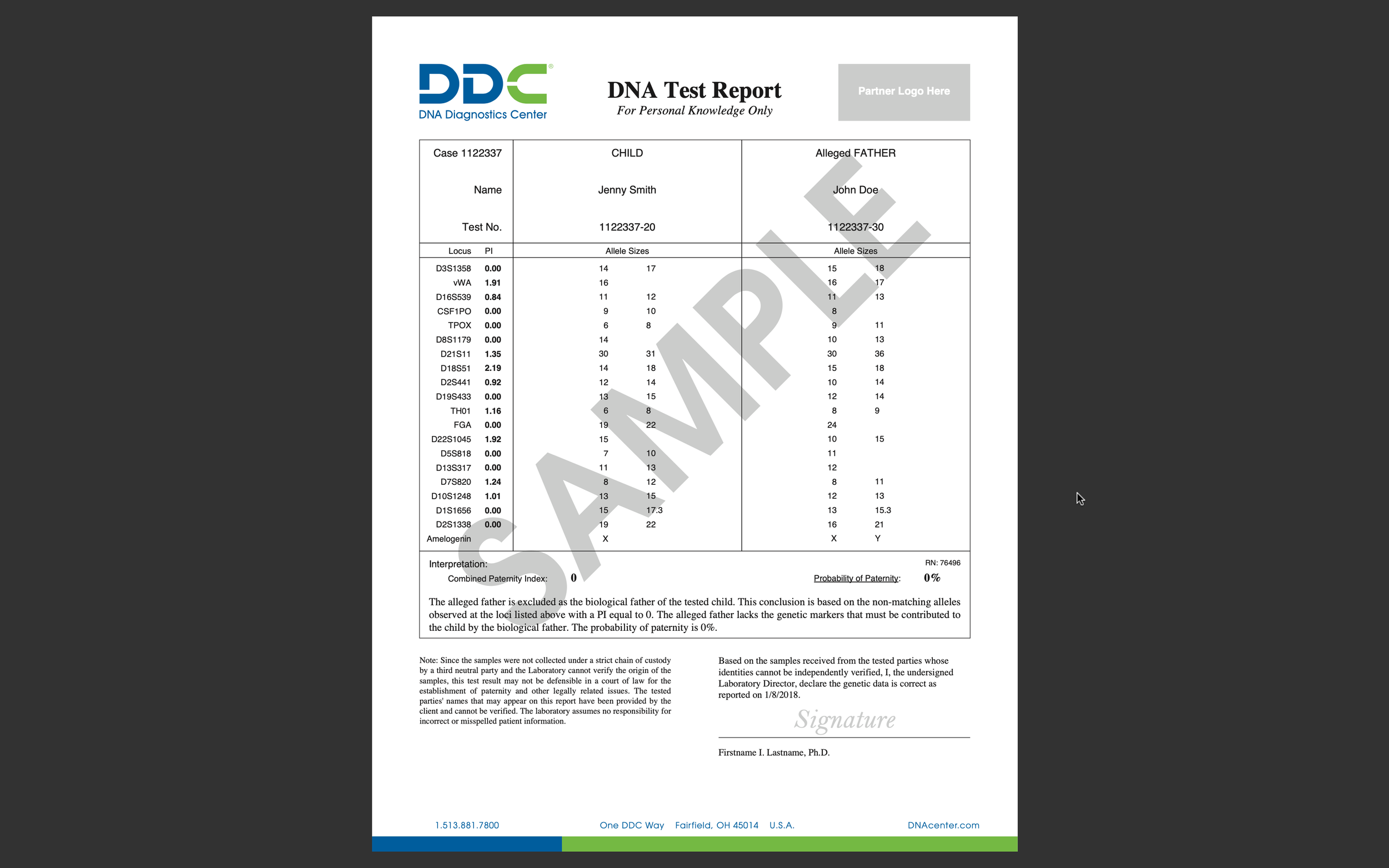
Get confidential paternity answers from home with GameDay DNA’s at-home paternity DNA test kit. This non-legal, informational test compares DNA from an alleged father and child using simple cheek-swab samples.
No blood draw, appointment, clinic visit, or laboratory visit is required. Collect samples privately at home, return them using the prepaid shipping materials, and receive your results by email after the laboratory completes testing.
Important: This is a non-legal, informational DNA test for personal knowledge only. It is not court-admissible and cannot be used for court, child support, custody, immigration, adoption, inheritance, birth-certificate changes, Social Security, or other official matters.
This at-home, non-legal DNA test is not available to residents of New York State, including New York City. New York law requires DNA relationship testing to be performed through a legal testing process with professional sample collection, identity verification, and documented chain of custody.
If you live in New York or need legally admissible results for any purpose, contact GameDay DNA before samples are collected to arrange a legal DNA test with identity verification and documented chain of custody.
Quick facts
What is this test?
A non-legal, informational at-home DNA paternity test
Who needs to participate?
The child and alleged father; the mother may be included if available
What type of sample is used?
A cheek-swab DNA sample from each participant
Is a blood draw required?
No
Is an appointment required?
No. Participants collect cheek-swab samples at home
How long do results take?
Typically within 2 business days after the laboratory receives all required samples
How are results delivered?
By email to the email address provided with the order
Can I use results in court?
No. A legal, witnessed, chain-of-custody test is required for official use
How is the kit shipped?
In a discreet USPS package; the exterior does not identify the type of test ordered
How do I return samples?
Use the prepaid return envelope and drop it at a FedEx location
How the at-home paternity test works
1. Order your at-home paternity test kit
Order your DNA kit online. GameDay DNA ships the kit in a discreet USPS package; the exterior shipping label does not reveal the type of DNA test ordered. Orders placed before 3:00 p.m. are generally shipped the same business day, while later or weekend orders are processed on the next business day. Delivery is typically estimated at 1–3 business days after shipment.
2. Collect cheek-swab samples at home
The child and alleged father each provide a painless cheek-swab sample using the materials included in the kit. The mother may also participate if available, although the basic test compares the alleged father and child.
Wash your hands before collection, follow the step-by-step instructions in the kit, and press each swab firmly against the inside of the cheek as directed. A cheek swab collects cells from the inside of the mouth; no needles or blood draw are needed.
3. Complete the informational paternity form
Complete the Informational Paternity Test Form included with the kit. For privacy, names on the form are not printed on the final report. Results identify participants by their testing roles, such as Alleged Father, Child, and Mother.
4. Return samples to the laboratory
Place each participant’s swab envelope and the completed paternity information form into the prepaid return envelope provided. Return the package through a FedEx office. For the fastest processing, send your samples to the laboratory the same day or the day after collection.
5. Receive confidential paternity results by email
The laboratory begins testing after it receives all required samples. Results are typically available within 2 business days after the lab receives the complete sample set. Your report is delivered to the email address provided with your order.
Who should use this test?
This at-home DNA paternity test is designed for people who want private, personal answers about a possible biological father-child relationship. It may be appropriate if you want information for peace of mind and do not need results for an official matter.
Choose a legal DNA paternity test instead if you may need the report for:
Court, child support, or custody
Immigration
A birth certificate or Social Security matter
Estate, inheritance, or other official documentation
Any proceeding requiring verified identities and documented chain of custody
A self-collected at-home test cannot generally be converted into a legal test after samples have been submitted.
What’s included
Your at-home paternity test kit includes the materials and instructions needed to:
Collect cheek-swab DNA samples from participants
Complete the required informational paternity form
Package samples for return
Return the completed kit using the prepaid return envelope
Follow all collection and shipping instructions in the kit to help prevent a delay or recollection request.
Privacy and discreet shipping
GameDay DNA ships home collection kits in a USPS package that does not reveal the type of test you ordered on the outside of the box. Your test results are sent confidentially to the email address provided with your order, and the report identifies participants by role rather than by the names entered on the informational form.
Returns and refunds
If you request a refund before the home collection kit ships, GameDay DNA provides a full refund. Once the kit has shipped, the sale is final and is not refundable under the Terms of Sale.
If you are purchasing a kit for someone else, contact GameDay DNA before ordering. For online orders, the individual who places the order is generally considered the Tested Party under the Terms of Sale.
Need help before ordering?
If you are unsure whether you need an at-home informational test or a legal, court-admissible paternity test, contact GameDay DNA before purchasing a kit.
Call 302-527-1789 or email info@gamedaydna.com.
Paternity Testing FAQs for Wyoming Families
Can I use an at-home paternity test in court in Wyoming?
No. An at-home paternity test is intended for non-legal personal knowledge. If you need results for court, child support, custody, immigration, inheritance, a birth certificate, or another official purpose, schedule legal testing with professional collection, identity verification, and documented chain of custody.
Do the mother and child need to participate?
The alleged father and child are generally the primary participants in a direct paternity test. The mother may be recommended because her DNA can provide additional genetic context, but the laboratory can confirm the appropriate participant arrangement for your situation.
Can I convert an at-home paternity test into a legal test later?
Usually, no. The samples must be collected through the legal chain-of-custody process from the beginning. If there is any chance you will need an official report, choose legal testing before samples are collected.
How long do legal paternity test results take?
Timing varies by laboratory, participant count, sample receipt, paperwork completion, and processing option. Ask for the current estimated turnaround time before scheduling. The laboratory’s processing time often starts after it receives all required samples and documentation.
What ID is required for legal paternity testing?
Adults generally need a current government-issued photo ID. Requirements for minors may vary by laboratory and collection site. Confirm all documentation requirements before the appointment.
Can paternity be established before a baby is born?
A non-invasive prenatal paternity test may evaluate paternity during pregnancy. Legal establishment of parentage can involve separate court, vital-records, or agency procedures, so confirm the appropriate legal process before relying on prenatal results for an official matter.
Can I use a DNA test to change a Wyoming birth certificate?
A DNA result alone may not be enough to amend a birth record. Wyoming Vital Statistics provides information about establishing paternity and required documentation. Depending on the situation, a properly completed affidavit or certified court order may be required.
Choose the Right Paternity Test in Wyoming
If you need answers for personal knowledge, an at-home paternity kit may be the appropriate choice. If you need results for a court, attorney, child-support case, immigration matter, estate claim, vital record, or another official purpose, begin with legal paternity testing.
Contact GameDay DNA with your ZIP code, preferred city, the relatives available to test, and how you plan to use the results. The team can help you compare legal paternity testing, at-home DNA kits, prenatal options, and available collection options before you schedule.
Follow us on Instagram and Twitter! If you have questions about paternity tests or other DNA testing services, please contact our Client Support Center at 302-529-1789, Mon-Fri from 8:00 AM to 5:30 PM Eastern Time. Our friendly, expert representatives are ready and happy to help. Get answers anytime by visiting our Help Center.
